


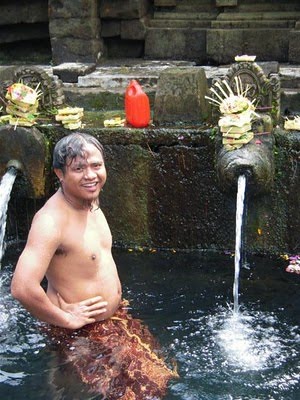
 This important temple one km north of the Tampaksiring village was founded as early as 962 AD. It is not as spectacular as Gunung Kawi a few km’s away, but absolutely worth a visit. Even if this is one of the oldest sites on Bali much of the structures are relatively new, it was completely restored in 1969. People from all over Bali come here to take a bath in the holy water for good health and good luck.The crystal clear water surfaces in a pool which, according to old traditions, is the Balinese Fountain of Eternal Youth. The pool is therefore protected by a wall. The surfacing water origins from the Batur lake via underground rivers.
Water is considered to be so important on Bali that it is used in almost all ceremonies and rituals. The Balinese religion is often called Agama Tirta; “The Religion of the Holy Water”. The water in Pura Tirta Empul is especially holy, all water used for cremations on Bali are taken from here and believed to have magical healing powers.Tirta Empul was built under the rule of Sri Candrabhaya Singha Warmadewa in the 10th century. Like other Balinese temples it is divided into three main courtyards: the front, the middle and the inner sanctum. Backing the outer courtyard are two rectangular bathing pools, one for men and one for women. According to tradition, each of the pool’s 15 fountains has its own name and function: spiritual purification, cleansing from evil, antidote to poison.
A legend tells the story about how the god Indra created the spring in Tirta Empul. His army had been poisoned by the demon king Mayadanava, and Indra made a hole in the Earth in order to tap “amerta”, the healing water which brought life back to his soldiers. An inscription with old-Balinese text, found in the Manukaya village north of Tampaksiring, tells about two pools built here in 962 AD. The inscription was finally deciphered in 1969, and described in detail a ritual cleansing of a holy stone during the full moon in the fourth month of the Balinese calendar.

Komentar